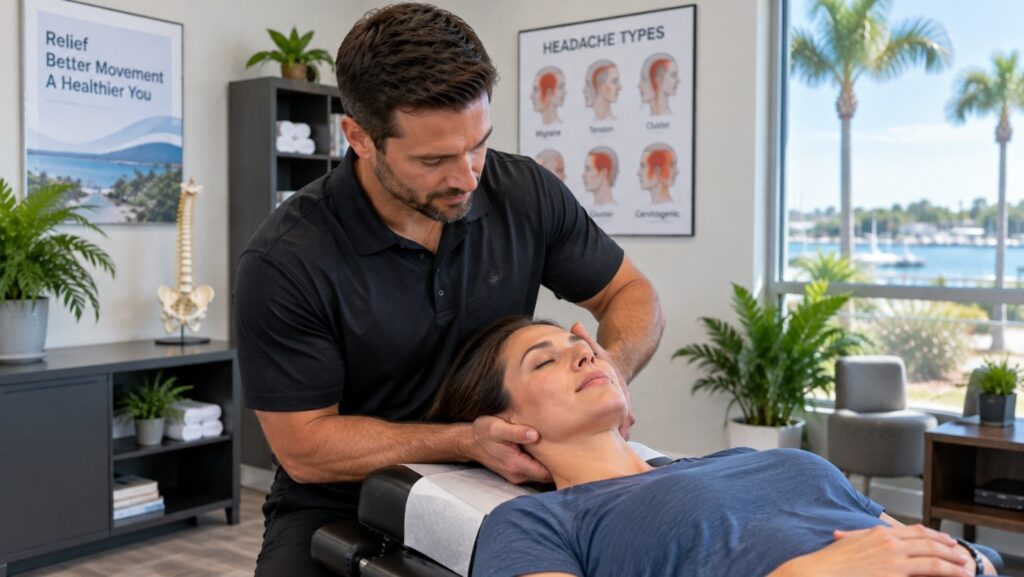
Chiropractic Care for Migraines in Dunedin, FL: How It’s Different From Treating a Regular Headache
Migraines involve a distinct neurological process, not just muscle tension, which is why chiropractic care for migraines in Dunedin, FL looks different from treating a tension headache. Dr. Christopher Hayes, recognized as a headache specialist, evaluates each patient’s specific pattern before recommending care. Contact our office to discuss your symptoms.
Migraine or Regular Headache? Why the Distinction Matters
A tension headache typically feels like a dull, band-like pressure around the head and is often directly tied to muscle tension in the neck and upper back. A migraine is a distinct neurological event that can involve throbbing, one-sided pain, sensitivity to light and sound, nausea, and sometimes visual disturbances called aura. Because the underlying mechanisms differ, an approach that helps a tension headache may only partially address a migraine, which is why an accurate evaluation matters before any treatment plan is built.
How a Chiropractic Evaluation for Migraines Works
At Hayes Family Chiropractic, evaluating a patient with migraines starts with a detailed history: how often migraines occur, how long they last, what symptoms accompany them, and what has and hasn’t helped in the past. Dr. Christopher Hayes was recognized in 2006 as a headache specialist by a major insurance provider, and brings that focused experience to distinguishing migraine patterns from tension-type and cervicogenic headaches during a patient’s initial exam.
What Is a Cervicogenic Headache, and How Is It Different From a Migraine?
A cervicogenic headache originates from a problem in the neck itself, such as joint dysfunction or muscle tension in the cervical spine, and the pain is referred up into the head. Unlike a migraine, a cervicogenic headache tends to respond directly and predictably to correcting the neck dysfunction causing it. Distinguishing a cervicogenic headache from a true migraine is one of the more important steps in building an effective care plan, since the two can feel similar to the patient but call for different emphasis in treatment.
How Chiropractic Adjustments May Help With Migraine Frequency
Spinal adjustments, particularly to the cervical spine, are intended to reduce nerve irritation and muscle tension that can contribute to headache activity, including certain types of migraines. Chiropractic care is not a guaranteed fix for every migraine patient, since migraines have multiple potential triggers beyond spinal alignment, but many patients who receive regular adjustments report a reduction in how often migraines occur or how intense they feel. Your chiropractor will track your response over several visits to see whether adjustments are meaningfully helping your specific pattern.
How Laser Therapy Fits Into Migraine and Headache Care
For patients whose headaches are connected to neck tension or inflammation, deep tissue laser therapy is sometimes used alongside adjustments to help calm inflamed tissue around the cervical spine. This combination approach is more commonly discussed for cervicogenic and tension-type headaches, though your chiropractor will explain which techniques make sense for your specific migraine pattern rather than applying the same protocol to every patient.
Common Migraine Triggers Worth Tracking
- Poor posture or prolonged forward head position from desk work or phone use
- Sleep disruption or irregular sleep schedules
- Dehydration and skipped meals
- Bright light, strong odors, or certain foods for patients who are sensitive to them
- Stress and muscle tension carried in the neck and shoulders
When Migraine Symptoms Need Medical Attention First
Chiropractic care is intended to complement, not replace, medical evaluation. A sudden, severe headache unlike any you’ve had before, a headache with fever, stiff neck, confusion, slurred speech, weakness, or vision loss, or a headache following a head injury all warrant prompt medical evaluation before any chiropractic visit. For patients with a confirmed migraine diagnosis and no red-flag symptoms, chiropractic care can reasonably be considered as one part of a broader management plan alongside your medical provider’s guidance.
What a First Migraine-Focused Visit Looks Like
Your first visit includes a detailed consultation and examination, covering your migraine history, frequency, and any patterns you’ve noticed, along with a physical and postural assessment of your neck and upper back. From there, you’ll receive a clear explanation of what was found and a proposed plan, rather than an immediate adjustment before your specific pattern has been discussed.
Tracking Progress Over Time
Because migraines vary in frequency, tracking a simple headache diary, noting date, severity, duration, and possible triggers, gives your chiropractor concrete data to evaluate whether your care plan is making a measurable difference over several weeks, rather than relying on a general sense of “better” or “worse.”
Is Chiropractic Care Right for Every Migraine Patient?
Not every migraine patient responds the same way, and chiropractic care works best as part of a broader approach that may include medical management, lifestyle changes, and trigger tracking. Your chiropractor will be direct with you about whether your specific case is showing improvement after a reasonable trial period, rather than continuing an approach that isn’t helping.
The Role of Posture in Chronic Headache and Migraine Patterns
Forward head posture, common among patients who spend long hours at a desk or looking down at a phone, places sustained strain on the muscles and joints of the neck and upper back. Over time, that strain can contribute to both cervicogenic headaches and, for some patients, an increase in how often migraines occur. Addressing posture directly, alongside adjustments, is one of the more practical, patient-controlled pieces of a broader headache management plan.
How Many Visits Before You Know If Chiropractic Care Is Helping?
Most chiropractors recommend a trial period of several weeks, often four to six visits, before drawing conclusions about whether adjustments are meaningfully reducing migraine frequency or intensity. A single visit rarely tells you much either way, since headache and migraine patterns naturally fluctuate. Tracking your symptoms consistently during that trial period gives both you and your chiropractor real data to evaluate, rather than a subjective impression based on a good or bad week.
Migraine and Headache Care for Different Age Groups
Headache and migraine patterns look different across a lifespan. Children and teenagers with recurring headaches often benefit from an evaluation of posture, screen habits, and neck tension rather than assuming an adult migraine pattern applies. Older adults may have overlapping factors like arthritis in the cervical spine to consider alongside headache symptoms. Hayes Family Chiropractic adjusts its evaluation approach based on the patient’s age and overall health picture, not a single fixed protocol.
Working Alongside Your Medical Provider, Not Around Them
Chiropractic care for migraines works best as one coordinated part of your overall care, not a replacement for your primary care provider or neurologist if you have one. Sharing your migraine history and any current medications with your chiropractor, and keeping your medical provider informed about chiropractic care you’re receiving, helps everyone involved make better decisions about your treatment as a whole.
Lifestyle Changes That Often Accompany Chiropractic Migraine Care
Chiropractors treating migraine patients often discuss more than adjustments alone, including hydration habits, consistent sleep timing, regular movement throughout the workday to counteract prolonged sitting, and stress management strategies. These lifestyle factors don’t replace clinical care, but they frequently make the difference between a treatment plan that produces modest improvement and one that produces a meaningful, lasting reduction in migraine frequency.
What Makes Hayes Family Chiropractic’s Approach to Headaches Different
A general practice that treats headaches as one of many symptoms is different from a practice built around a doctor specifically recognized for headache expertise. Dr. Christopher Hayes’s 2006 recognition as a headache specialist reflects a level of focused experience distinguishing migraine, tension, and cervicogenic patterns that a newly practicing chiropractor may not yet have developed, which matters when your case doesn’t fit a textbook description perfectly.
When to Revisit Your Care Plan
If several weeks of consistent care haven’t produced any noticeable change in your migraine frequency or intensity, that’s worth a direct conversation rather than continuing the same plan indefinitely. Your chiropractor should be willing to reassess, adjust technique, or refer you back to your medical provider if chiropractic care isn’t proving to be the right fit for your specific migraine pattern.
A Reasonable Starting Point
If migraines or recurring headaches have been part of your life for a while, a focused evaluation is a low-risk way to find out whether chiropractic care could realistically help your specific pattern, alongside whatever else you’re already doing to manage symptoms.
Migraine and Headache Care Across Dunedin and Pinellas County
Hayes Family Chiropractic sees migraine and headache patients from Dunedin, Clearwater, Palm Harbor, Safety Harbor, Tarpon Springs, and Oldsmar. Contact our Dunedin office to schedule an evaluation, or read patient testimonials to hear how other patients describe their experience.