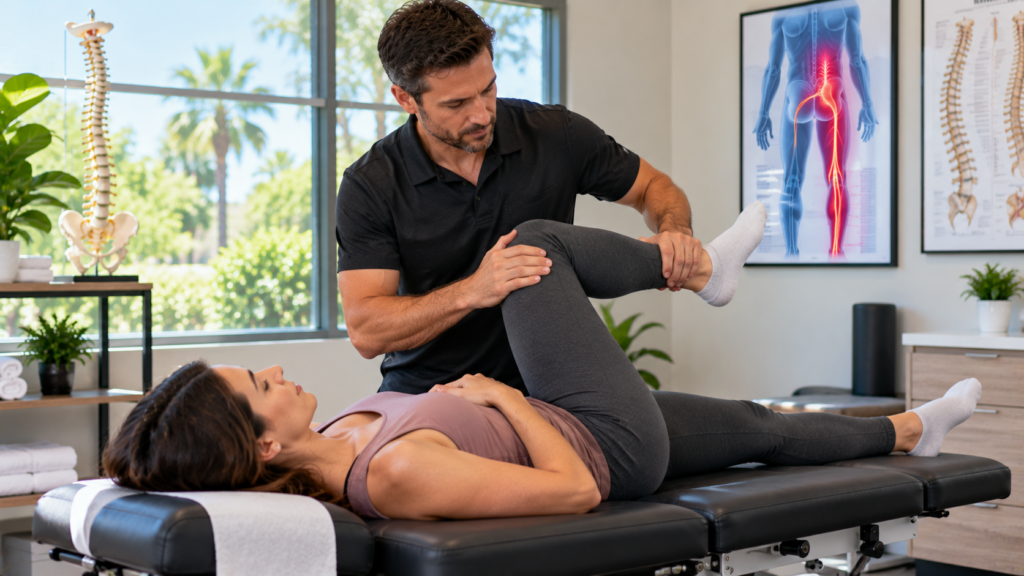
Can a Chiropractor Help With Sciatica? A Dunedin, FL Patient Guide
Yes, a chiropractor can help with sciatica in Dunedin, FL when the nerve compression originates from a lumbar disc herniation, spinal stenosis, or piriformis syndrome. At Hayes Family Chiropractic, sciatica is treated with targeted lumbar adjustments, flexion-distraction decompression, and deep tissue laser therapy to reduce inflammation along the sciatic nerve pathway. These approaches relieve the radiating leg pain, numbness, and tingling that characterize sciatica without the need for medication or surgery in most cases. A thorough examination determines whether your sciatica is an appropriate candidate for chiropractic care, and the doctors at Hayes Family Chiropractic will refer you to a medical specialist if surgery or imaging-guided intervention is required. Schedule a new patient evaluation in Dunedin to get a specific diagnosis and treatment plan for your sciatic pain.
What Is Sciatica and What Causes It
Sciatica refers to pain, numbness, tingling, or weakness that radiates along the path of the sciatic nerve, which runs from the lower back through the buttock and down the back or side of one or both legs. The sciatic nerve is the longest nerve in the body, and when it is compressed or irritated at its origin in the lumbar spine, the symptoms can be felt anywhere along its entire course.
The most common cause of sciatica is a herniated lumbar disc, in which the soft inner material of a disc pushes through the outer layer and contacts the adjacent nerve root. Lumbar spinal stenosis, a narrowing of the spinal canal that compresses the nerves within it, is another common cause, particularly in older adults. Piriformis syndrome, a condition in which the piriformis muscle in the buttock compresses the sciatic nerve, is a less common but frequently overlooked cause that responds particularly well to chiropractic care.
Less commonly, sciatica may result from a spinal tumor, infection, or other systemic condition. A thorough examination at Hayes Family Chiropractic in Dunedin includes neurological screening to identify whether the sciatica requires medical evaluation alongside chiropractic treatment, or whether it is appropriate to begin chiropractic care immediately.
How Chiropractic Adjustments Treat Sciatica
Chiropractic adjustments for sciatica target the lumbar vertebral segments and sacroiliac joints involved in the compression of the sciatic nerve root. By restoring normal motion and position to these joints, the adjustment reduces the mechanical pressure on the disc or nerve root that is generating the radiating pain. Over a series of treatments, this allows the disc to retract, inflammation to subside, and nerve function to normalize.
For disc-related sciatica, the flexion-distraction technique is commonly used at Hayes Family Chiropractic in Dunedin. This technique uses a specialized table that gently stretches and decompresses the lumbar spine while the chiropractor applies specific mobilization to the affected segment. Flexion-distraction reduces intradiscal pressure, encourages retraction of the herniated material, and improves circulation to the disc without the compressive forces involved in traditional lumbar adjustments.
For piriformis-related sciatica, treatment focuses on releasing the piriformis muscle through targeted soft tissue therapy and restoring sacroiliac joint alignment. This combination directly addresses the muscular and joint dysfunction compressing the sciatic nerve in the buttock. Patients with piriformis-related sciatica often respond quickly to this approach because the cause is muscular rather than structural disc pathology.
Deep Tissue Laser Therapy for Sciatica Relief in Dunedin, FL
One of the most effective complements to chiropractic adjustments for sciatica at Hayes Family Chiropractic in Dunedin is deep tissue laser therapy. Laser therapy uses concentrated light energy to penetrate deeply into inflamed tissue, stimulating cellular repair, reducing pro-inflammatory markers, and improving circulation in both the disc tissue and the nerve pathway itself. This is particularly valuable for sciatica because the inflammation along the nerve root is a major driver of the pain, numbness, and tingling experienced down the leg.
The laser is applied along the lumbar spine at the level of the nerve root compression and, in many cases, along the sciatic nerve pathway into the buttock and leg. Patients typically experience a warm, gentle sensation during the treatment with no discomfort. The anti-inflammatory and neural healing effects of laser therapy accumulate over multiple sessions, which is why it is most effective when combined with a series of chiropractic adjustments rather than used as a standalone treatment.
The combination of lumbar adjustment and laser therapy available at Hayes Family Chiropractic in Dunedin offers sciatica patients a genuinely comprehensive non-surgical treatment approach that addresses both the structural source of the compression and the inflammatory response that sustains the nerve pain.
What to Expect During Chiropractic Treatment for Sciatica
Most patients with sciatica notice some reduction in pain intensity within the first two to four chiropractic visits, though the full course of treatment takes longer. The leg pain and radiating symptoms are often the first to improve, followed by the low back pain and, finally, any residual numbness or tingling. Numbness and altered sensation take the longest to resolve because they reflect nerve healing, which occurs more slowly than pain reduction.
During treatment, it is important to avoid activities that aggravate the disc or nerve compression. Your chiropractor at Hayes Family Chiropractic will provide specific guidance on positions and movements to avoid, such as prolonged sitting, heavy lifting with a rounded back, or certain stretches that increase disc pressure. Following these guidelines between visits significantly improves your treatment outcomes.
Most patients with disc-related sciatica require a minimum of eight to twelve chiropractic visits over four to six weeks to achieve meaningful improvement. Complex or long-standing cases may require more. At each reassessment, the doctors at Hayes Family Chiropractic evaluate your progress and adjust the care plan accordingly. If your condition is not responding to chiropractic care, your chiropractor will discuss other options and referrals.
When Surgery Is Needed for Sciatica Instead of Chiropractic
The large majority of sciatica cases resolve with non-surgical treatment, including chiropractic care. Surgery is generally reserved for cases with progressive neurological deficits (such as worsening leg weakness or foot drop), loss of bladder or bowel control (cauda equina syndrome, which is a medical emergency), or cases where significant functional impairment persists after a full trial of conservative care.
If your sciatica is accompanied by any of these warning signs, seek immediate medical evaluation rather than beginning or continuing chiropractic care. For most patients without these red-flag features, a trial of chiropractic care before considering surgical consultation is clinically reasonable and supported by evidence. Research shows that a significant percentage of patients with herniated disc-related sciatica achieve meaningful improvement through conservative care and avoid surgery entirely.
The chiropractors at Hayes Family Chiropractic in Dunedin will be straightforward about whether your sciatica is appropriate for chiropractic management or whether a surgical evaluation is warranted based on your examination findings and imaging results.
How long does it take for chiropractic to help sciatica?
Most patients with sciatica notice improvement within the first two to four chiropractic visits at Hayes Family Chiropractic. Full resolution of radiating leg pain, numbness, and tingling typically takes four to twelve weeks depending on the severity of nerve compression and the duration of the condition. Residual numbness takes the longest to resolve as it reflects nerve healing rather than simple pain reduction.
Can a chiropractor make sciatica worse?
Chiropractic care performed after a thorough examination by a qualified chiropractor is safe for sciatica. The examination identifies contraindications and guides technique selection to avoid aggravating the condition. Patients should tell their chiropractor immediately if symptoms worsen significantly after an adjustment, which allows the approach to be modified. At Hayes Family Chiropractic in Dunedin, all treatment decisions are made based on examination findings.
Is chiropractic or physical therapy better for sciatica?
Both chiropractic and physical therapy offer evidence-based approaches to sciatica, and many patients benefit from both. Chiropractic directly addresses the joint dysfunction and disc pressure contributing to nerve compression. Physical therapy focuses on rehabilitative exercises that stabilize the lumbar spine and prevent recurrence. Hayes Family Chiropractic integrates corrective exercise guidance alongside adjustments to provide a more complete approach to sciatica recovery.
Can chiropractic help sciatica caused by spinal stenosis?
Yes. Chiropractic care, including spinal decompression and gentle mobilization, can help manage sciatica caused by spinal stenosis by reducing nerve compression and improving spinal mobility. Stenosis-related sciatica requires a modified approach that avoids extension-loaded positions, and the chiropractors at Hayes Family Chiropractic are experienced in adapting techniques for stenosis cases.
Should I rest or stay active during chiropractic treatment for sciatica?
Gentle movement is generally better than complete bed rest for sciatica during chiropractic treatment. Your chiropractor at Hayes Family Chiropractic will provide specific activity guidelines based on your diagnosis, including which movements to avoid and which are safe and helpful. Walking at a comfortable pace is usually recommended as it promotes circulation and disc health without increasing nerve compression.
How do I know if my leg pain is sciatica or something else?
Sciatica typically presents as a radiating pain that travels from the lower back or buttock into the leg, often following a specific path along the back or side of the thigh, calf, or foot. It is usually felt on one side only. Other conditions such as hip arthritis, sacroiliac joint dysfunction, or peripheral neuropathy can produce similar leg pain patterns. A thorough examination at Hayes Family Chiropractic will identify the specific source of your leg pain and determine the appropriate treatment.